El futuro simple
Free to teach as-is — the teacher guide, student handout, and slides are included.
Free — we'll email you an access link. Google Docs format.
Objective
Puedo conjugar verbos regulares en el futuro simple.
Part 1 of 4
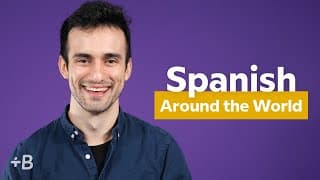
Warm-up video
Lingo Learner · 6:40
We don't generate video — this one is by Lingo Learner on YouTube. The practice questions and exit ticket below were drafted by AI for this objective, and every question is editable in the teacher guide.
Part 2 of 4
Key concepts
3 concepts
- 1
In Spanish, the future tense, or ''el futuro simple'', is formed by adding specific endings to the infinitive of the verb.
- 2
For regular verbs in the future tense, you simply keep the infinitive form and add the endings: -é, -ás, -á, -emos, -éis, -án.
- 3
Although there are 12 irregular verbs in the future tense, they follow the same endings as regular verbs, but with a modified stem.
Part 3 of 4
Practice
8 questions
¿Cuál es la diferencia principal entre usar 'ir a + infinitivo' y el futuro simple en español, según el video?
Completa la siguiente frase con la forma correcta del futuro simple del verbo 'hablar': Yo ________ español en España.
Part 4 of 4
Exit ticket
Quick comprehension check
“Conjuga el verbo 'bailar' en el futuro simple para todas las formas (yo, tú, él/ella/usted, nosotros, vosotros, ellos/ellas/ustedes).”
Sample answer included in the free materials
Get the materials
Teacher guide, student handout, and slides — free, in Google Docs format
Teacher Guide
Complete lesson plan with answer keys and alternate activities
Student Handout
Printable worksheet
Slides
Ready to present
We'll ask for your email to send your access link — nothing else.
Teaching a group at a different level?
Where are your students right now? We'll rebuild this lesson to match — including the teacher guide, student handout, and slides, saved to your Google Drive.
Adapt This Lesson