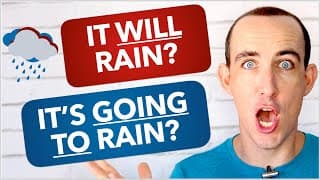
Expressing Future Plans
Free to teach as-is — the teacher guide, student handout, and slides are included.
Free — we'll email you an access link. Google Docs format.
Objective
I can use "will," "going to," and present continuous to express future plans.
Part 1 of 4
Warm-up video
English with Greg · 9:31
We don't generate video — this one is by English with Greg on YouTube. The practice questions and exit ticket below were drafted by AI for this objective, and every question is editable in the teacher guide.
Part 2 of 4
Key concepts
3 concepts
- 1
We use will when we decide something at the moment of speaking, such as saying 'I'll bring some drinks' when invited to a football game.
- 2
We use 'be going to' when there is intention to do something, and we use the present continuous when the plan is in your diary with a specific date and time.
- 3
When making predictions about the future, use 'going to' when the prediction is based on obvious facts or evidence, and use will when there is no evidence.
Part 3 of 4
Practice
8 questions
Complete the sentence with the correct form: 'I ________ (help) you with your homework later tonight.' (decision made at the moment of speaking)
Which future form is most appropriate for expressing a pre-existing intention?
Part 4 of 4
Exit ticket
Quick comprehension check
“Write three sentences about your plans for next weekend. Use "will", "going to", and the present continuous in separate sentences to describe three different plans.”
Sample answer included in the free materials
Get the materials
Teacher guide, student handout, and slides — free, in Google Docs format
Teacher Guide
Complete lesson plan with answer keys and alternate activities
Student Handout
Printable worksheet
Slides
Ready to present
We'll ask for your email to send your access link — nothing else.
Teaching a group at a different level?
Where are your students right now? We'll rebuild this lesson to match — including the teacher guide, student handout, and slides, saved to your Google Drive.
Adapt This Lesson