Mole Ratios in Reactions
Free to teach as-is — the teacher guide, student handout, and slides are included.
Free — we'll email you an access link. Google Docs format.
Objective
I can use mole ratios to calculate the amount of reactants and products in a chemical reaction.
Part 1 of 4
Warm-up video
Professor Dave Explains · 6:06Vetted channel
We don't generate video — this one is by Professor Dave Explains on YouTube. The practice questions and exit ticket below were drafted by AI for this objective, and every question is editable in the teacher guide.
Part 2 of 4
Key concepts
3 concepts
- 1
A mole is a very large number, specifically 6.022 x 10²³, and is called Avogadro's number.
- 2
The molar mass of a substance is the mass of one mole of that substance, expressed in grams.
- 3
In stoichiometric calculations, you can convert from mass to moles of one substance, then to moles and mass of another substance using mole ratios from the balanced equation.
Part 3 of 4
Practice
9 questions
What is a mole, and why is it important in chemistry?
Explain how to determine the molar mass of a compound.
Part 4 of 4
Exit ticket
Quick comprehension check
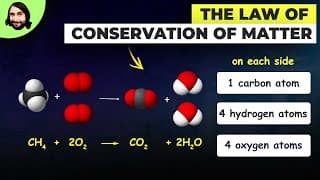
“If you start with 10 grams of methane (CH₄) in a combustion reaction, how many grams of carbon dioxide (CO₂) will be produced? Show all steps, including calculating molar masses, converting to moles, using the mole ratio, and converting back to grams. The balanced equation is CH₄ + 2O₂ → CO₂ + 2H₂O.”
Sample answer included in the free materials
Get the materials
Teacher guide, student handout, and slides — free, in Google Docs format
Teacher Guide
Complete lesson plan with answer keys and alternate activities
Student Handout
Printable worksheet
Slides
Ready to present
We'll ask for your email to send your access link — nothing else.
Teaching a group at a different level?
Where are your students right now? We'll rebuild this lesson to match — including the teacher guide, student handout, and slides, saved to your Google Drive.
Adapt This Lesson