Behavioral Learning Theories
Free to teach as-is — the teacher guide, student handout, and slides are included.
Free — we'll email you an access link. Google Docs format.
Objective
I can summarize the key principles of behavioral learning theories.
Part 1 of 4
Warm-up video
CrashCourse · 11:49Vetted channel
We don't generate video — this one is by CrashCourse on YouTube. The practice questions and exit ticket below were drafted by AI for this objective, and every question is editable in the teacher guide.
Part 2 of 4
Key concepts
3 concepts
- 1
Ivan Pavlov's experiments are among the most famous in the history of psychology and contributed to the foundation of the behaviorist school of thought.
- 2
In classical conditioning, the unconditioned stimulus is paired with the neutral stimulus during conditioning until the neutral stimulus becomes a conditioned stimulus eliciting a conditioned response.
- 3
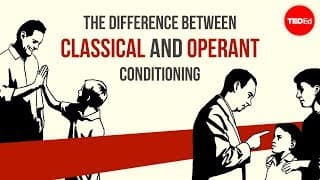
Operant conditioning involves associating our own behavior with consequences, where behaviors increase when followed by reinforcement or reward, but decrease when followed by punishment.
Part 3 of 4
Practice
4 questions
According to the video, what is the primary focus of the behaviorist school of thought?
Explain the difference between classical conditioning and operant conditioning, as described in the video.
Part 4 of 4
Exit ticket
Quick comprehension check
“Summarize the key principles of behavioral learning theories as discussed in the video. Include a brief description of classical conditioning and operant conditioning.”
Sample answer included in the free materials
Get the materials
Teacher guide, student handout, and slides — free, in Google Docs format
Teacher Guide
Complete lesson plan with answer keys and alternate activities
Student Handout
Printable worksheet
Slides
Ready to present
We'll ask for your email to send your access link — nothing else.
Teaching a group at a different level?
Where are your students right now? We'll rebuild this lesson to match — including the teacher guide, student handout, and slides, saved to your Google Drive.
Adapt This Lesson